A treatment is failing somewhere past the skin. The medicine has to be carried, molecule by molecule, to receptor sites buried deep in living tissue — by a swarm smaller than a red blood cell, in a window shorter than a held breath. You can't drive them. You write the code they carry in, and then you let go.
The immune system doesn't know you're helping. The bloodstream only runs one way. And another team's protocol is in the same body, racing you for the same sites — because only one of them gets used on a real patient.
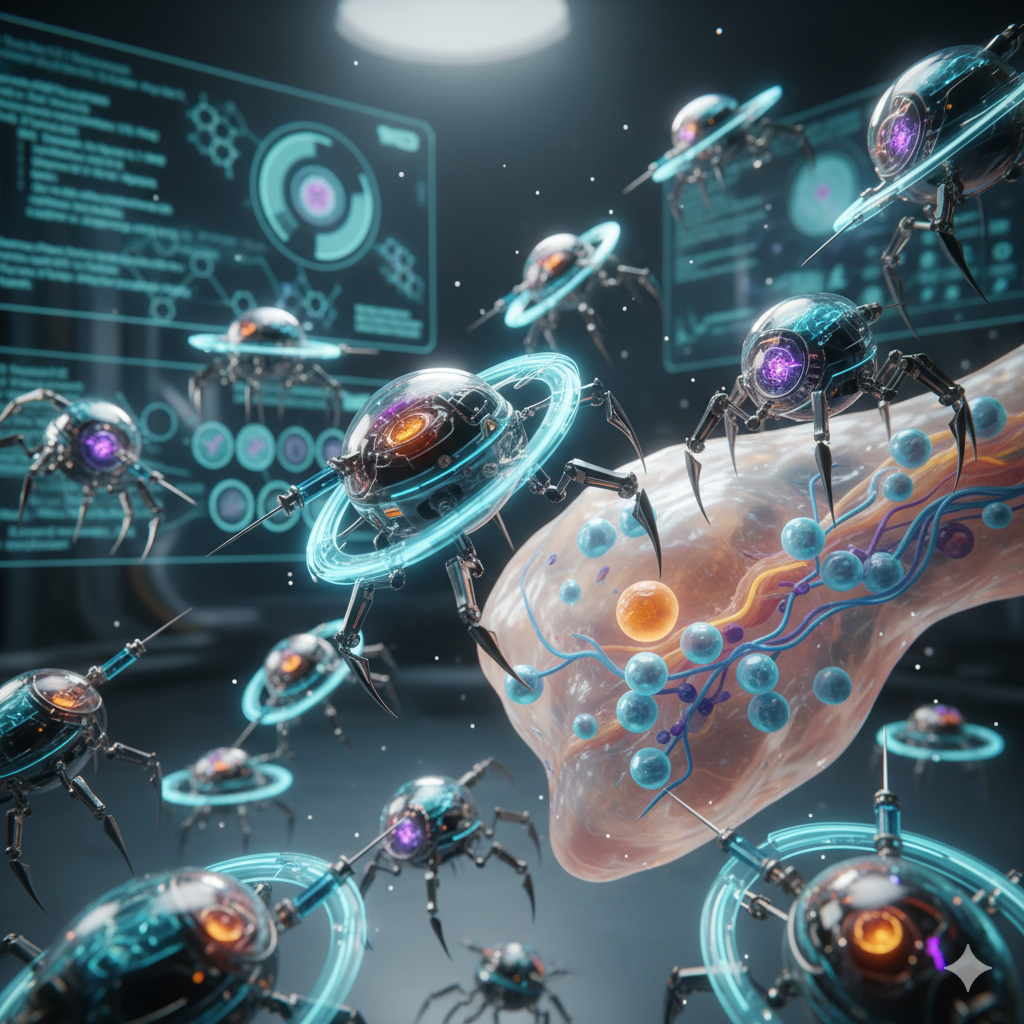
Nothing here is an arbitrary game mechanic. Each one is the patient — or your rival — behaving exactly as they should.
AZN breaks down before it reaches deep tissue, so it has to be hauled molecule by molecule to receptor sites and held there by an implant. An empty needle barely treats anything — a fed one does the real work.
White blood cells can't tell a nanobot from a bacterium. It isn't malice — it's the patient's own defences working correctly, with your swarm in the way. Route around them, wall them out, or burn them down; they don't come back.
Bloodstreams are the fastest roads in the body and they run in exactly one direction. Riding one crosses the map in a fraction of the time — and you can't turn around on it.
Your bots sense only what's near them. The rival swarm is out there somewhere and you won't know where until something of yours stops reporting — unless you spend the mass on an Explorer and buy eyes.
That's the treatment window before the compound denatures. And your code gets 50 ms to decide each turn — how long the swarm can wait for orders before the moment has passed. Take longer and the turn is simply gone.
Two candidate swarms run in the same simulated body, on the same failing tissue, against the same clock. Whoever holds more of the patient stable when the window closes is the one that goes to a real patient.
The patient, the immune system, the window — and the part nobody tells you at the start: underneath the tissue, this is one of the most useful problems in computer science. Autonomous agents doing the right thing when you aren't there to tell them.
Open the briefing →Built in Python + pygame — one script sets up a virtualenv and launches the app.
Paint terrain, place streams, habitats, AZN nodes, and zones. Save/load maps as JSON. Full undo support.
Tissue density, bloodstream currents, bone barriers — and patrolling white cells that attack both sides. Route around the immune system, wall it off, or gun it down.
Scouts that see through the fog of war, walls that block shots, collectors that double as artillery — every stat matters, from a 150 AZN starting budget.
Scrub 1 500 turns with a jump-to-turn slider, watch attack tracers and event effects, follow the match story in the events feed, and rerun any seed exactly.
Run matches at hundreds of turns per second from the command line. Iterate fast without opening the app.
Hand-pick your field of competitors (multi-select supported) and run a round-robin tournament with live standings.
Your entire strategy lives in a single Python file. Two methods to override, a clean read-only map snapshot each turn.
You begin every match with one NanoAI and 150 AZN in the bank. Everything else you build.


nano-bot runs on Python 3.10+ with pygame for the map editor and replay viewer. The simulation engine itself has no pygame dependency at all — it runs identically headless, in the GUI, or inside a unit test. Your strategy is also plain Python, so there's no second language or engine to learn.
Most systems already have it. Check with python3 --version.
That's all you need — the strategy API is two methods on a plain class.
API reference →
Clone the project and run ./run.sh — it creates a virtualenv and installs
dependencies on first run automatically.
This started as a Godot/GDScript project. The simulation rules, scoring, and JSON formats are unchanged — but GDScript's per-file class-name resolution and silently-ignored duplicate function definitions kept causing friction during development. Plain Python has neither problem, no engine to install, and is a language most participants already know.
run.sh creates a virtualenv and installs dependencies the first time you run it.
git clone https://github.com/Habitas-Games/nano-bot-python.git cd nano-bot-python ./run.sh
Copy the starter and override two methods. That's your entire interface with the simulation.
cp strategies/example_strategy.py strategies/my_strategy.py
from nanobot.api.nano_strategy import NanoStrategy
class MyStrategy(NanoStrategy):
def choose_injection_point(self, map_info):
return (0, 0) # pick a cell in your zone
def what_to_do_next(self, map_info, my_bots):
pass # command your bots here
Hit Run Match in the main menu. The match window opens with a first match already simulated — pick your map and both strategies right there and press Restart to re-simulate in place. Each full 1 500-turn match computes in seconds.
Learn to code from zero — variables, decisions, loops, functions — with every concept introduced because your swarm needs it. Eight lessons, ending in a real working strategy that wins on every map.
Learn to program →Runnable code at every step, from "plants one needle" to a strategy that beats an
aggressor — with the measured result each time (Stage 1 → 2 is a 43×
scoring jump; Stage 3 goes from 0/24 to 20/24 against example_combat).
Complete API reference, scoring formulas, map mechanics, bot stats, strategy tips, and a line-by-line walkthrough of the example strategy.
Open the guide →Paste docs/STRATEGY_API.md into the chat — the entire API in one
plain-text page with a verified working example, written so an assistant can't
invent a different one. Paste the contents, not a link.
nano-bot is on GitHub at Habitas-Games/nano-bot-python — contributions of all kinds are welcome.
New bot type, map mechanic, or viewer improvement? Ideas are welcome.
→ Open an issueFork the repo, make your changes, and open a PR. Small focused changes merge fastest.
→ Pull requestsShare your strategy as an example. A diverse library of approaches helps participants learn faster.
→ Browse strategies/nano-bot is built and maintained as a side project — no company, no VC, no team. If it's been useful to you, any contribution helps cover the time it takes to keep it going.
Banco Pichincha (Ecuador). Scan the QR with your banking app.
Most of what keeps a project like this alive isn't money — it's people using it and saying so.